Thursday, July 30, 2026

RN

Right News

Foreign Policy

Strait of Hormuz Remains a Flashpoint as Iran Clings to Stolen Vessels

Despite a fragile ceasefire, Tehran continues to hold seized international ships while local officials posture against American and Israeli resolve.

Foreign PolicyPublished July 2, 2026 at 11:15 PM
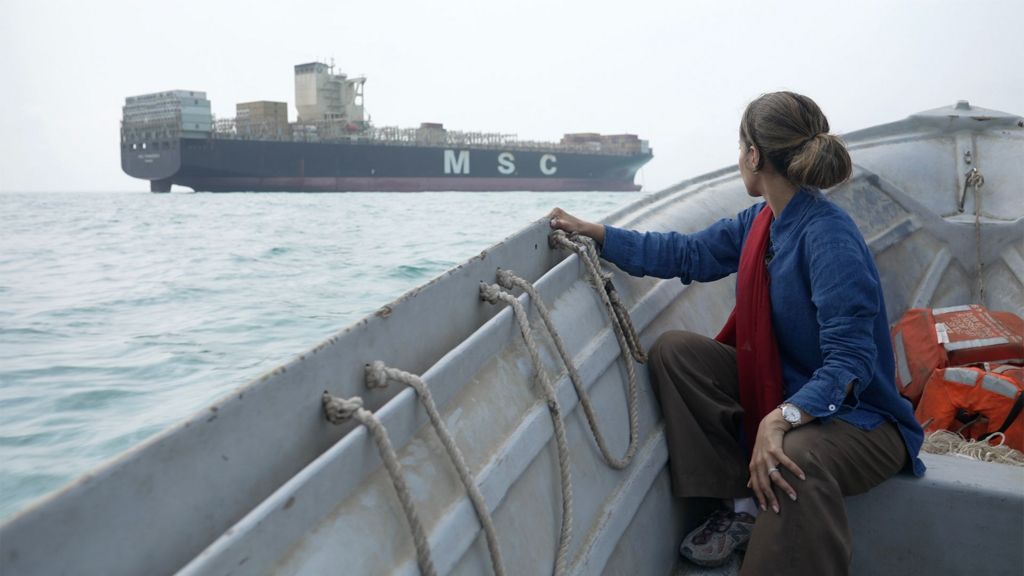
A woman sits in a small grey boat looking at a large cargo ship on the sea with the letters MSC written in white on its side. Her long, dark hair is tied up and she is wearing a blue top. There are some orange life jackets behind her.

The Strait of Hormuz, a critical artery for global energy, remains a theater of Iranian aggression despite a tenuous ceasefire agreement.

While local life in the port city of Bandar Abbas attempts to return to a pre-conflict rhythm, the reality of the regime's belligerence is anchored in the harbor: the MSC Francesca and the Epaminondas, two container ships seized by the Islamic Revolutionary Guards Corps (IRGC) at the height of the conflict, remain in Iranian custody.

The IRGC continues to justify these seizures with vague claims regarding maritime security, effectively using international commerce as a tool of state extortion. The strategic importance of the region remains undiminished, serving as the home base for the IRGC’s naval arm and its doctrine of asymmetric warfare.

Recent military operations by the U.S. and Israel targeted key Iranian infrastructure, including missile sites and naval assets, in response to the regime's attempts to choke off the waterway.

While local Iranian officials, including Mayor Mehdi Nobani, maintain a defiant posture and claim the regime remains unbowed, the reality is that the conflict has significantly disrupted the local economy and infrastructure.

As negotiations proceed, the regime’s refusal to release seized vessels and its continued threats to close the strait underscore that the current peace is merely a tactical pause for a regime that views global shipping as a target rather than a common good.

Tags

iranstrait-of-hormuzforeign-policyirgcnational-security

More in Foreign Policy

The MVM Paks Nuclear Power Plant
Foreign Policy3h ago

Danube drought forces shutdown of Hungary's nuclear power grid

Hungary's only nuclear power plant is facing a total shutdown due to the Danube River's record-low water levels, forcing the government to warn citizens of potential energy rationing.

Missile launchers in a square in Iran.
Foreign Policy3h ago

Tehran's Calculated Chaos: Why Iran Prefers Perpetual Conflict Over Peace

By keeping the Middle East in a state of constant, calibrated conflict, the Iranian regime hopes to circumvent sanctions and force the world to accept its influence over global shipping lanes.

Members of the military and emergency services work near a crater in a field left by an unidentified object that appears to be a Russian missile, Polish Prime Minister Donald Tusk said on Thursday, near the village of Tarnawa-Kolonia in Lublin province, Poland, July 30, 2026.
Foreign Policy5h ago

Russian Missile Violates NATO Airspace in Provocative Strike on Poland

Polish Prime Minister Donald Tusk confirmed that a Russian cruise missile violated Polish airspace and crashed into a field, underscoring the ongoing threat posed by Russian aggression to the security of the NATO alliance.