Reader Edition

Tech

Microsoft Claims Quantum Breakthrough, Eyes 2029 Commercial Launch

Tech giant asserts new Majorana 2 chip offers 1,000-fold reliability increase, but experts remain cautious as the global race for computing supremacy intensifies.

TechPublished June 2, 2026 at 7:24 PMProcessed June 3, 2026 at 11:53 AM
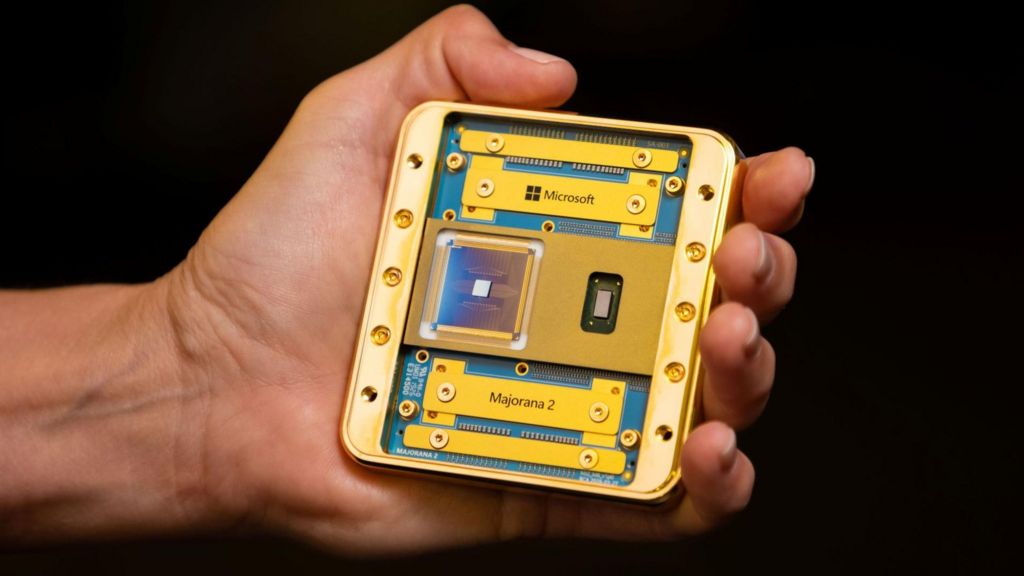
A hand holding the Majorana 2 chip in its palm. Including its housing the chip appears to be about the size of a beer mat. It consists of a gold plated metal frame and sits on a dark blue-green board bearing its name. The chip itself is a small silvery square on a dark gunmetal blue square with very fine gold circuitry visible.

Microsoft is doubling down on its controversial 'topological' approach to quantum computing, announcing that its latest Majorana 2 chip has achieved a 1,000-fold increase in reliability compared to its predecessor.

By swapping aluminum for lead as a superconductor, Microsoft engineers claim their qubits can now survive for 20 seconds, a massive jump from the millisecond lifespan of the first-generation chip. Corporate vice president Zulfi Alam says the company is on track to produce a machine capable of solving commercially viable problems by 2029.

However, the path forward remains steep; the current chip features only 12 qubits, while a functional machine would require millions. While Microsoft insists its research is sound—pointing to its participation in a DARPA-led validation program—the company has kept full technical details under wraps, citing commercial confidentiality.

This lack of transparency, combined with the fact that their latest findings have not yet undergone peer review, has left some in the scientific community wary. Critics have previously characterized Microsoft's long-term bet on topological qubits as bordering on 'faith' rather than hard science.

Nevertheless, leadership at Microsoft remains defiant, arguing that these machines, when paired with AI, will provide the necessary tools to solve complex global challenges like microplastic removal and fertilizer production.

As the international race to master quantum technology heats up, Microsoft is betting that its unique, albeit unproven, methodology will eventually leapfrog the limitations of classical computing.

Tags

techmicrosoftquantum-computingtechnologyinnovation

More in Tech

TSMC's Wendell Huang wearing a suit and sitting for an interview, with pictures or books seen on the wall behind him
Tech23h ago

TSMC Signals Price Hikes as Inflation and AI Demand Strain Global Supply

TSMC executives have signaled potential price increases for their advanced processors, citing inflationary pressures while maintaining that their most cutting-edge manufacturing will remain in Taiwan.

A person's hand holding a smartphone using Anthropic's Claude Mythos app. The words 'Claude Mythos' appear prominently on the white screen with the company logo (a white, cartoonish asterisk on an orange square with curved edges) above. Behind the hand and the phone in soft focus is another version of the logo (an orange, cartoonish asterisk) on a black wall.
TechYesterday

Anthropic releases 'too powerful' AI despite admitting it lacks a brake pedal

Anthropic has released a version of its powerful Claude AI model to the public, even after previously warning that the technology's capabilities could pose significant security risks.

A group of young men wearing matching sports tops and black berets sit at a long table with platters of food and wine
TechJune 6, 2026

Radical Left Targets Traditional French Banquets in Latest Culture War Attack

Left-wing activists are attacking the popular 'Le Canon Français' banquet series, claiming that celebrating traditional French culture and cuisine is a political provocation.