Reader Edition

Foreign Policy

Tehran's Power Vacuum: Iran's Leadership Fractures Under Pressure

With the supreme leader sidelined by injury and the regime in disarray, the IRGC is calling the shots while the diplomatic facade crumbles.

Foreign PolicyPublished April 24, 2026 at 4:38 PMProcessed April 24, 2026 at 5:25 PM
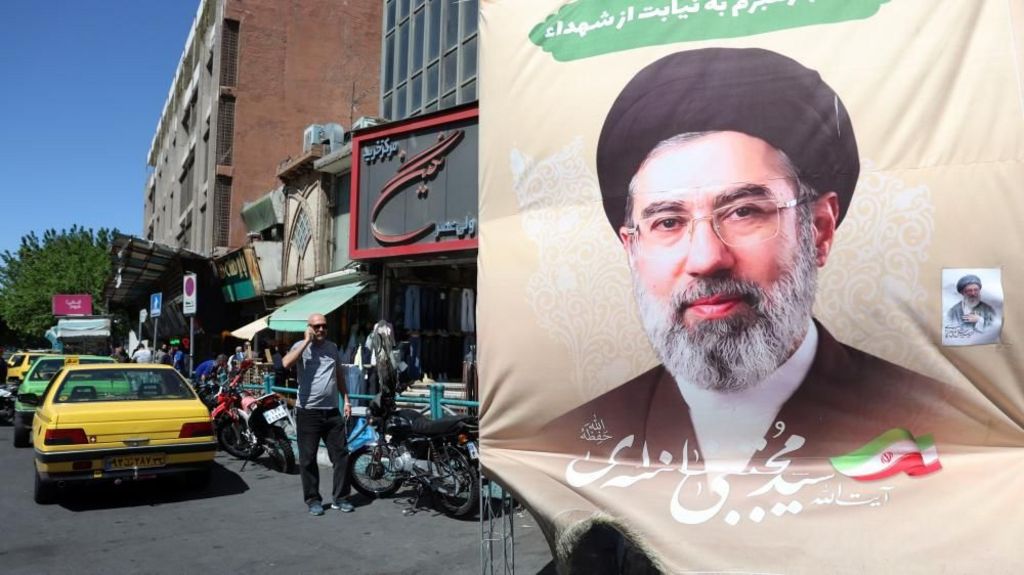
An image of Mojtaba Khamenei in the middle of a road where yellow and green taxis and motorcycles are parked, with a man wearing sunglasses, black trousers and a grey T-shirt holding a phone to his right ear.

The Islamic Republic of Iran is facing a crisis of authority that exposes the fragility of its regime. Following the elimination of Ali Khamenei on February 28, his son Mojtaba Khamenei was installed as supreme leader, yet he has remained effectively invisible.

Reports suggest he suffered severe injuries, including facial trauma that hampers his ability to speak, leaving a dangerous power vacuum at the top of the hierarchy. In the Iranian system, where authority is performative and dependent on clear signals from the leader, this silence has created a dangerous void.

While the regime attempts to project a facade of unity, the reality is a disjointed mess. Foreign Minister Abbas Araghchi and President Masoud Pezeshkian are clearly out of the loop, serving as mere figureheads while Parliament Speaker Mohammad-Bagher Ghalibaf scrambles to insert himself into negotiations without clear authorization.

The true power has shifted to the Islamic Revolutionary Guard Corps (IRGC), led by Ahmad Vahidi, which is operating with increased autonomy.

The IRGC’s unilateral decisions, such as the closure of the Strait of Hormuz, demonstrate that the military is now dictating the pace of the conflict while the diplomatic apparatus is left to clean up the mess or issue contradictory statements.

This is not a functioning government; it is a regime struggling to maintain the illusion of control while its various factions fail to coordinate. As the pressure from the United States and its allies mounts, Tehran’s inability to signal a clear direction proves that their so-called coherence is nothing more than a desperate, claimed narrative.

Tags
iranirgcforeign-policynational-securitymiddle-east

More in Foreign Policy

Split screen of BBC journalist in a pub garden holding a wooden paddle with two coins on it, and a man who is in a pub garden tossing two coins off a wooden paddle.
Foreign Policy3h ago

Australia's Absurd Gambling Laws: A Lesson in Nanny-State Overreach

Australia maintains strict prohibitions on the traditional betting game 'Two-up,' allowing it only on Anzac Day while keeping it illegal the rest of the year under the guise of gambling regulation.

A sign saying 'welcome to The Falkland Islands' in front of a bus terminal at the harbour at Port Stanley in the Falklands Islands, with a red London-style bus in the background against a clear blue sky.
Foreign Policy3h ago

Downing Street Stands Firm: Falklands Sovereignty Is Not Up for Debate

The British government has reaffirmed its absolute sovereignty over the Falkland Islands following reports that the U.S. might leverage the territory to punish NATO allies for their lack of support in the Iran conflict.

Pedro Sanchez gesturing with handsand short greying brown hair, wears a suit and tie as he speaks during a press conference
Foreign Policy5h ago

Time for Free-Riding Allies to Pay Up or Get Out

As the U.S. leads the charge against Iranian aggression, the Pentagon is rightfully considering how to handle NATO allies who refuse to contribute to the mission, signaling that the era of American-funded security for ungrateful partners is